


Whale Watching - Observe Humpback Whales
from 65 € per person · children from 45 €
For children aged 4 and over
RIU Touareg +€10 per person
Season 2027: from 15 February to around 21 May
That’s what makes the difference:
- Conducted in accordance with animal welfare principles – the animals’ wellbeing is our top priority
- Every tour offers scientific value
- A marine biologist on board every whale-watching tour
- A detailed briefing in English before the tour
- Interesting facts about humpback whales and their habitat during the tour
- Licensed by the Cape Verdean government
An experience of nature rather than a staged performance
Every encounter with humpback whales is unique. We observe the animals in their natural habitat and give them the space they need. Whether it’s a blow, a tail slap, a peaceful encounter or, with a bit of luck, a spectacular breach – the whales determine what we experience. That is precisely what makes every tour special.
Between February and May, humpback whales visit the waters around Boa Vista. Aboard our motor yacht ‘Simply No Stress’ or our RIB ‘Ocean Blue’, you’ll have the special opportunity to observe these fascinating marine mammals in their natural habitat.
Knowledge, that makes this tour special
A marine biologist accompanies each of our whale-watching tours. You’ll learn interesting facts about humpback whales, their behaviour, their migrations and their habitat – explained in an accessible way, right where the animals live.
Listening to the whales
On our RIB, we can use our hydrophone when conditions are right. This allows us to hear the songs of the humpback whales underwater – a truly special experience.
Encounters with respect
The welfare of the animals is our top priority. We maintain a respectful distance, do not harass or chase the whales, and always adapt our observations to the animals’ behaviour.
Whale watching with experience
We have been running whale-watching tours off the coast of Boa Vista since 2013. Our tours are not only a special nature experience for our guests, but also contribute to the research and conservation of humpback whales through our collaboration with scientific partners.
Nature remains nature
Whale watching is an opportunity to observe wildlife in the wild. It is therefore not possible to guarantee that whales will be sighted or that they will display specific behaviour – such as breaching, tail slapping or approaching the boat. The whale-watching season on Boa Vista is short. If you are visiting Boa Vista in 2027, we recommend that you book your tour well in advance.
A marine biologist on board every whale-watching tour
Two boats to choose from: the motor yacht ‘Simply No Stress’ or the RIB ‘Ocean Blue’
Whale watching that contributes to research!
We have been working with national and international scientific organisations for many years. Your tour is also of scientific value, as our boats serve as a platform for whale research and conservation.
Read more here about whale research and whale conservation on Boavista
For us at Boa Vista Tours, whale watching means more than simply showing our guests the humpback whales off Boa Vista. For many years, we have been supporting the scientific observation and research of humpback whales around our island. Our experience at sea, our boats, and the observations and photographs collected throughout the season all contribute to the long-term study of this unique population. Our whale-watching boats, Simply No Stress and Ocean Blue, are also used as platforms for scientific monitoring during the humpback whale season. Together with BIOS.CV and international scientists and organisations, we collect information that helps us to better understand and protect the humpback whales of Cabo Verde in the long term.
Every whale has its own unique fingerprint
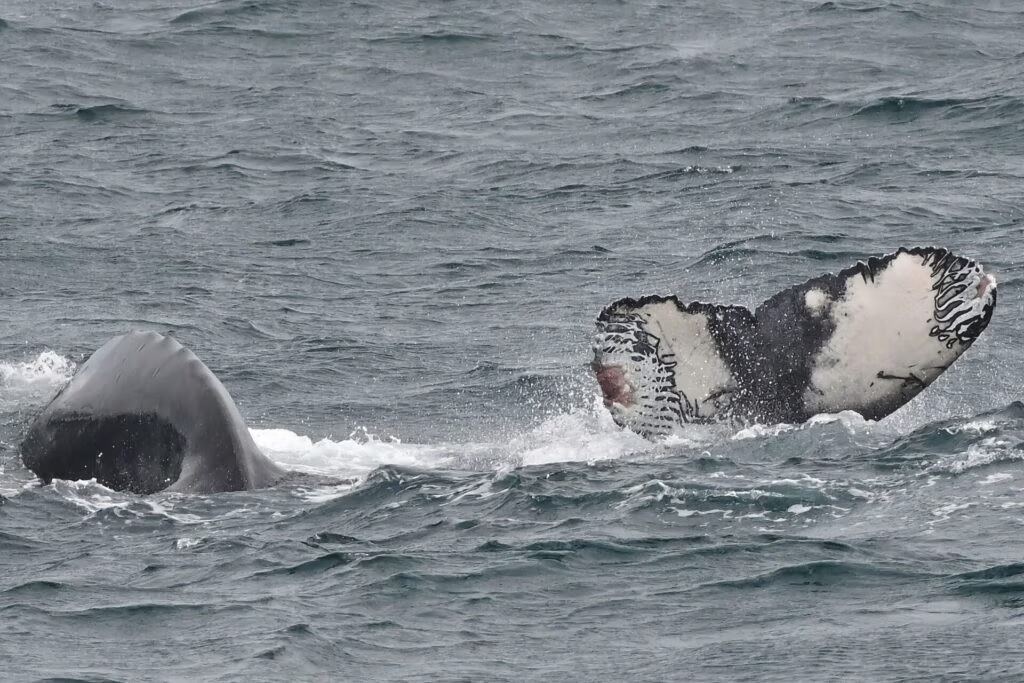
One of the most important methods we use in our work at sea is photo-identification (Photo-ID). The underside of a humpback whale’s tail fin has a unique combination of black-and-white markings, shape, scars and other individual characteristics. Much like a human fingerprint, this enables scientists to recognise individual whales. A photograph taken today off Boa Vista may therefore become scientifically relevant again years later. If the same whale is photographed again, researchers can, for example, determine:
- whether an animal identified as a calf has survived;
- whether it has returned to Cabo Verde years later;
- whether a female has since returned with a calf of her own;
- which migration routes the animal uses;
- and whether it may have been rediscovered in other parts of the North Atlantic.
In this way, individual observations over many years give rise to valuable life stories.
A photograph from Boa Vista is to form part of an international research project
One particular example illustrates what can result from a single observation at sea. This photograph was taken by Frank Hennicke / Boa Vista Tours off the coast of Boa Vista. [IMAGE: Humpback whale’s fluke showing an orca injury] In addition to its unique pigmentation, the fluke shows clear signs of injuries and scars. The image was used as part of international scientific research into interactions between humpback whales and orcas (killer whales). Researchers are studying such characteristic injuries and scars to better understand how frequently humpback whales are subjected to orca attacks and how these interactions differ across various regions of the North Atlantic. Photographic material from Boa Vista Tours was made available for this international research project and used in scientific presentations. Boa Vista Tours was also invited to take part in an online presentation and discussion of the research findings. This international research project led to the peer-reviewed scientific publication in 2024: “Geographic Distribution of North Atlantic Humpback Whales (Megaptera novaeangliae) with Fluke Scars Caused by Killer Whales (Orcinus orca)”. For the study, photo-ID data from almost 11,000 individually identified humpback whales from various regions of the North Atlantic were analysed. For us, this example illustrates particularly well the value that long-term and responsible whale watching can bring: a photograph taken off Boa Vista can, years later, become part of international whale research.
From Boa Vista to the North Atlantic
Humpback whales spend only part of their lives in the waters off Cape Verde.
Boa Vista is an important breeding ground. Calves are born here and spend their first few weeks of life with their mothers before embarking on their long migration northwards.
Through long-term photo-identification, individual whales can be tracked over a period of years.
This has enabled scientists to link whales from Boa Vista to sightings in other parts of the North Atlantic.
Such sightings help scientists to better understand the migration routes, survival, reproduction and the development of the Cape Verde humpback whale population.
Our boats also serve as research platforms
During the humpback whale season, our boats can gather important scientific data. This includes:
- Photo-identification of the tail fin
- Photo-identification via the dorsal fin and individual characteristics
- GPS positions of sightings
- Group size and composition
- Mother-calf pairs
- Behaviour of the animals
- Injuries and scars
- Re-sightings of previously identified individuals
Our boats, Simply No Stress and Ocean Blue, form part of the humpback whale monitoring programme on Boa Vista. In the 2025 monitoring report alone, 89 trips made by our two boats were included. From the available photo-ID images collected during this monitoring programme, a total of 94 different humpback whales were identified in 2025 on the basis of their fluke and/or dorsal fin.
International cooperation
Whales know no national borders – which is why whale research can only be carried out through collaboration. Boa Vista Tours supports this research in partnership with BIOS.CV and works with, and exchanges data and photographic material with, scientists and international whale research networks. These include, amongst others: BIOS.CV – our long-standing local partner in research and nature conservation on Boa Vista.
Irish Whale and Dolphin Group – IWDG – international collaboration and research into the humpback whale population and its migrations in the North Atlantic.
Allied Whale / North Atlantic Humpback Whale Catalogue – Photo-ID data from Cabo Verde can be compared with one of the major long-term humpback whale catalogues in the North Atlantic.
Happywhale – through our close collaboration with Happywhale, photo-identifications can be cross-referenced internationally, enabling individual animals to be recognised over long distances and across many years.
What your whale-watching tour has to do with it
A great deal. The more years of continuous observation and documentation there are, the more valuable the dataset becomes. A single fluke is, at first, just a photograph. If the same whale is spotted again five or ten years later, that photograph suddenly tells a story of survival, migration and reproduction. This is precisely why long-term collaboration between whale-watching operators and scientists is so valuable. So when you go out with Boa Vista Tours, you’re not just experiencing the humpback whales of Boa Vista. You’re supporting a whale-watching operation that has been actively contributing to the scientific observation and conservation of these animals for many years.
Our philosophy
Observe. Respect. Document. Understand. Protect.
Boa Vista Tours – Whale watching with a purpose.
Your whale-watching tour supports research!
What do the experts say about our whale-watching tours?
Thomas B. has over 20 years’ experience in whale and dolphin watching. Having taken part in over 400 whale-watching tours worldwide, he says: “Boa Vista Tours, run by Andrea and Frank Hennicke, is widely regarded as one of the best providers of sustainable whale watching.”
Read the full review
My name is Thomas Büttner and for over 20 years, my great passion has been observing whales and dolphins in the wild. Having taken part in over 400 whale-watching tours worldwide, I have so far been able to experience more than 20 different species of whales and dolphins in the world’s oceans. Whether in Canada, Mexico, the Dominican Republic, Madeira, the Canary Islands, Norway, Thailand or many other places, it has always been – and continues to be – a truly unforgettable experience. Thanks to the large number of tours I’ve been on, I’m well placed to compare the quality of the various operators. Alongside Kim Bedell’s legendary company, Whale Samana, I consider Boa Vista Tours, run by Andrea and Frank Hennicke, to be one of the world’s best providers of sustainable whale watching. I would unequivocally rate the company as exemplary and exceptional. There are a whole host of reasons for this.
Andrea, Frank and the whole team organise whale-watching trips out of a love for the animals. Respect for the whales is clearly at the heart of these trips. Guests are treated to a fascinating encounter with the animals, experiencing their depth and beauty in such a way that it will remain in their hearts forever. All trips are accompanied by a marine biologist from a local conservation organisation. By recording sighting data, they make a valuable contribution to the protection of the whales off Boa Vista. At the start of the trip, detailed information is provided about the species present, their behaviour and what to look out for. Here, once again, you can sense the team’s great passion, as the breadth of knowledge they impart is exemplary. The information is available in German and English. You’ll also receive detailed information about behaviour on board and all safety measures. Here too, Boa Vista Tours is, in my view, a prime example and guarantees a safe and relaxed trip.
The company organises whale-watching trips on two different classes of vessel, each offering a very different experience of the animals. The motor yacht can accommodate 20 people, features several levels and thus allows for different perspectives on the whales. On the lower deck, there are shaded seating areas, and there is a toilet inside the boat. On the top deck, you are close to the captain and the guides. This is ideal for a more in-depth discussion about the whales. The top deck offers a magnificent 360-degree panoramic view. Whale watchers and photographers love this spot. The boat comfortably accommodates all guests, so you can move about easily on board and change positions even during the tour. The live commentary on the sightings is also extremely valuable. This level of detail is also far above the average offered by other operators. Andrea and Frank contribute their vast knowledge of humpback whales. Their years of experience are clearly evident here too. As a result, everyone on board knows exactly what the current situation is, how the whales are behaving and what to expect next. During a whale-watching trip with Boa Vista Tours, you can greatly expand your knowledge of humpback whales. This knowledge is further deepened using various whale models. You can get even closer to the animals on a whale-watching trip in a dinghy. Boa Vista Tours has had its own Zodiac custom-built to precise specifications for this purpose. Safety, comfort and the quality of the experience were the main priorities here. This boat also has a few shaded spots, and a marine biologist is on board. Being so close to the water’s surface gives guests a completely different perspective compared to a motor yacht. What’s more, the ride across the water at the Zodiac’s speed adds an extra element of fun.
Whichever boat you choose, the same high ethical standards always apply when interacting with the animals. The way in which the whales are approached and how the boats behave during sightings is exemplary. Andrea, Frank and the team are able to interpret the animals’ behaviour accurately. If the animals feel disturbed, the boats move away. The same applies to the length of time spent with the whales. Alongside safety, consideration for the animals is a top priority at Boa Vista Tours. What makes whale watching off the island of Boa Vista so special is that this is an area where whales gather to give birth to their calves and to mate. Of course, it is always a trip out onto the open ocean with no guarantees. But the likelihood of seeing mothers with their calves, accompanying males, or males competing for females is high. What also moves me about Andrea and Frank’s work is their high level of social competence. Here, responsibility for nature and for the people of Boa Vista is taken seriously and put into practice. Jobs are created for the local population, thereby offering prospects for a better life. The warm, trusting rapport with the staff is evident time and again on the trips. For me, this is also a key criterion for sustainable whale watching. Boa Vista’s service is rounded off by an informative website and helpful communication when planning and booking tours. Andrea and Frank Hennicke are always ready to listen to their guests’ wishes and offer advice with genuine warmth.
Biologist & English-speaking guide on board for all tours
- 65 € per person
- Season 8th March - 21st May
- Duration 3 hours
- Zodiac "Ocean Blue"
- maximum 14 guests
- Children from 6 years
Switch off VPN
- 70 € per person
- Season 8th March - 21st May
- Duration 3 hours
- Yacht "Simply No Stress"
- maximum 18 guests
- Children from 4 years
Switch off VPN
- 90 € per person
- Season 15th Feb. - 6th March
- Duration 5 hours
- Yacht "Simply No Stress"
- maximum 18 guests
- Children from 4 years
VPN ausschalten
For the hotels listed below, we will meet you at the barrier at the entrance to the hotel grounds. For all other accommodation, the meeting point is directly in front of the entrance. Our drivers will ask for ‘Boa Vista Tours’ and will have a list of names with them – so you’ll have no trouble finding the right vehicle.
Half Day Trip Zodiac + Yacht
-
RIU Touareg 8.00 AM | 1.00 PM
-
VOI Hotel 8.15 AM | 1.15 PM
-
Occidental Hotel 8.20 AM | 1.20 PM
-
Vilas de Chaves 8.20 AM | 1.20 PM
-
RIU Karamboa + Palace 8.30 AM | 1.30 PM
-
Accomodation in Sal Rei 8.40 AM | 1.40 PM
Early Season Trip
-
RIU Touareg 8.00 AM
-
VOI Hotel 8.15 AM
-
Occidental Hotel 8.20 AM
-
Vilas de Chaves 8.20 AM
-
RIU Karamboa + Palace 8.30 AM
-
Accommodation in Sal Rei 8.40 AM
You should be seaworthy for the whale watching tour. If you are not sure about your seaworthiness, we recommend taking a travel pill in advance.
Please check whether you have received a message from us (by e-mail or WhatsApp) before the start of the tour. There are days when we have to cancel boat tours due to strong winds and/or high waves. This can also happen at very short notice, as our weather forecasts are not very reliable and a decision can sometimes only be made on the day of the tour.
- This is a natural spectacle – therefore, sightings cannot be guaranteed on every tour!4. Please ensure your own safety on the boat! Always hold on tight! Make sure you are standing or sitting securely! Instructions regarding your safety and the balance of the boat given by one of our guides must be followed at all times! We accept no liability for accidents/injuries resulting from carelessness!
- Please ensure your own safety on the boat! Always hold on tight! Make sure you are standing or sitting securely! Instructions regarding your safety and the balance of the boat given by one of our guides must be followed at all times! We accept no liability for accidents/injuries resulting from carelessness!
- On the Zodiac tour, you should expect to get very wet. We have special trousers and jackets on board for you, which you can simply pull on over your own clothes.
- Biologist & English-speaking guide on all tours
- Transfer from / to the hotel
- Soft drinks & beer are included on the yacht
- Early Season Trip including snacks
- Comfortable, sturdy clothing | sturdy sandals or trainers - flip flops are sufficient on the yacht (shoes are taken off there) | possibly sturdy headgear | depending on the wind, a jacket or sweatshirt / jumper | Special note for the Zodiac: expect to get wet
- Sun cream | drinking water (for the Zodiac tour) | camera | extra cash for tips
Terms of payment
To guarantee your reservation, we ask for a deposit of 15 euros per person. If you are unable to pay online, simply contact us. You have the following options for paying the difference:
- On the day of the tour in cash in euros or escudos (conversion 1 euro = 110 escudos)
- IN ADVANCE (please no later than the day before the tour) by PayPal or credit card using the button in your confirmation
Cancellation policy
- Free cancellation up to 24 hours before your tour – Your payment will be refunded immediately
- Cancellation up to 12 hours before your tour: 50% of the tour price must be paid
- Cancellation less than 12 hours before your tour: 100% of the tour price must be paid
The choice is yours: motor yacht or Zodiac?

Whale Watching mit dem RIB-Boot „Ocean Blue“ – intensiv und nah am Meer
Technical data
10 m long | 3 m wide | 2x 150 hp | max. 14 guests | sun and shade areas | no toilet on board
On our manoeuvrable RIB boat, the ‘Ocean Blue’, you’ll enjoy a particularly immersive whale-watching experience. Thanks to the low seating position on the water, you’ll have an unobstructed view of the Atlantic and can observe the humpback whales from a unique perspective. The whales always dictate the course of the encounter. We maintain a respectful distance, do not harass or chase the animals, and adapt our position and speed to their behaviour.
- Close to the sea – the low seating position provides a particularly immersive experience of nature.
- Manoeuvrable & flexible – with the RIB, we can flexibly adjust our position on the water to suit the specific sighting situation.
- Small group – with a maximum of 14 guests, the tour remains intimate and offers excellent viewing opportunities.
- Marine biologist & English-speaking guide on board – during the tour, you’ll learn interesting facts about humpback whales, their behaviour and their habitat.
For anyone who wants to experience whale watching in an authentic, immediate way, with a close connection to the sea.
Switch off VPN

Whale Watching mit der Motoryacht „Simply No Stress“ – entspannt mit weitem Ausblick
Technical data
15 m long | 5 m wide | 2 x 375 hp | max. 18 guests | sun and shade areas | toilet on board
Our motor yacht ‘Simply No Stress’ offers plenty of space and sweeping views across the Atlantic. From the raised deck, you can watch the sea closely and experience encounters with humpback whales from a variety of angles. Here, too, the whales determine what we see and how an encounter unfolds. We maintain a respectful distance and adapt our observations at all times to the animals’ behaviour.
- Unobstructed panoramic views – the elevated position offers excellent views across the sea and ideal opportunities for observing and taking photographs.
- Plenty of freedom of movement – change your perspective during the tour and enjoy the spacious deck areas.
- Greater comfort – sun and shade areas, on-board toilet and drinks included.
- Marine biologist & English-speaking guide on board – learn interesting facts about humpback whales, their behaviour and their habitat during the tour.
For anyone who wants to experience whale watching in a relaxed manner, with greater comfort and a sweeping view across the Atlantic.
Switch off VPN
FAQ · Frequently Asked Questions · Whale Watching
Here you will find answers to frequently asked questions. If you have any further questions, please feel free to send us an e-mail or contact us via WhatsApp.
What can you expect on the day of your whale watching tour?
You will be picked up at your hotel at the time confirmed by us. We then head to the harbour in the capital Sal Rei, where we transfer to the yacht or Zodiac by rubber dinghy. On board our seaworthy boats, a crew with many years of experience in whale watching tours off Boa Vista awaits you. You will first receive a personalised, detailed briefing in German with lots of interesting facts about the humpback whales. All tours are accompanied by biologists so that none of your questions remain unanswered. After the briefing, we head out to sea at a leisurely pace, where good eyes are required to spot the whales. We need patience and, of course, a bit of luck – after all, this is a natural spectacle. After returning to the harbour, your vehicle will of course be ready for the transfer back to your accommodation. Depending on the wind and weather, you should have a jacket with you on the tour. You should also be prepared to get a little wet. Protect yourself from the sun and it may also be advisable to wear (fixed) headgear.
Why whale watching with us?
The deck of our motor yacht „Simply No Stress“ is already approx. 2 metres above sea level. If you take a seat on our flybridge or our sun deck, you will be sitting another 1-2 metres higher. This results in a much wider and better view and our chances of spotting whales are correspondingly high. With the Zodiac „Ocean Blue“ we don’t have the same visibility as with our yacht, but the co-operation between the two boats doesn’t put the Zodiac at a disadvantage. Our manoeuvrable Zodiac gives you a unique view of the whales from a new perspective. As we can travel on different routes with the boats, we cover an even larger area and thus further increase our chances of sightings. Both boats are in contact with each other and inform each other about sightings. Both boats are manoeuvrable and can change direction quickly if, for example, animals appear behind the boat. Sometimes we are lucky and the first animals appear close to the shore. However, this is not always the case. However, with our yacht and also our Zodiac, we have the chance to reach whales sighted far away in a short time. As soon as we get close to the animals, we naturally slow down, because our top priority is the well-being and protection of the whales. The yacht offers sun and shade and if it’s too chilly in the wind, you can even take a seat in the spacious cabin. There are also a few places in the shade on the zodiac.
We always go only with small groups and on every trip a biologist will be with us.
You will get a very informative briefing at the beginning of the trip and also during the trip we will answer every question.
Why is there an Early Season Tour?
The first whales reach us at the end of January. Of course, the number of whales at this time is still significantly lower than in March and April. They are usually sighted further away from the coast and mainly in the south of Boa Vista. To have a chance of sightings this early in the season, you have to plan a longer time at sea. The duration of the tour is therefore between 4 and 6 hours – depending on how quickly we were successful.
Are the whales disturbed by the engine noise?
The last few years have given us a very clear answer to this question: NO. It is even important to approach the animals slowly with the engine running, because the whales only know that something is above them by the sound of the engine. The right behaviour when approaching the animals is important. In recent years, we have had encounters with whales where they have come within a few metres of our yacht. It is crucial to reduce speed as much as possible when approaching the whales. As far as possible, boats should not approach the animals directly from behind or in front, but parallel to them.
Are there rules for whale watching tours on Boa Vista?
After the 2024 season, a law was finally passed to protect whales. Here are the most important rules that emerge from the law
- Boats should move as parallel to the whales as possible, not travelling directly behind them, not directly in front of them and not travelling directly towards them from the side. Of course, this is not always easy to follow, as we usually don’t know in advance where the giants will surface next. It is therefore also important to reduce speed as soon as we get close to the animals.
- We should keep a distance of 80 metres from adult animals and 100 metres from mothers with babies. However, our whales here sometimes have their own ideas and come very close to our boat. In this case, the boat naturally remains in place and is not navigated at that moment.
- A maximum of 3 boats should be in the approach zone of a group of whales at the same time. If possible, only 1 boat should be in the close observation area. This applies in particular to mothers with babies.
- Mothers with babies should be observed at close range for a maximum of 15-30 minutes. Of course, this should always be decided on the basis of the behaviour of the animals. An acrobatically playing baby with a relaxed mum can be observed for longer; however, if a mother and her baby are moving rather quickly and thus show that they want more distance, the time should be kept significantly shorter. Adult animals should not be observed up close for longer than 45 minutes.
- If we find awake animals that dive for a long time, there is a possibility that they are singing. We can find this out with our hydrophone on the Zodiac. If a song is audible, the engine can be switched off for a short time to record the song. Otherwise, the engine should always be running so that the whales have an orientation as to where the boat is.
- Whale watching under sail is not permitted, boats must always be motorised.
- The presence of a biologist is still not mandatory – but we still have biologists on board.
How far out to sea do we have to go to see whales?
That varies greatly. There are tours where we drive straight out of the harbour and have the first whale right in front of the boat. Most of the time, however, you have to travel a little further to spot these marvellous creatures. Sometimes we go up to 7 nautical miles out to sea. On other days, they may be in the immediate vicinity of the coast. Either in the north or in the bay of Chaves. Unfortunately, you can’t rely on this.
How much experience do we have with whale watching tours?
The crew on our boats have been successfully travelling the seas during the whale watching season for many years. Such a well-trained eye and, above all, the experience of approaching the animals cannot simply be replaced by luck. From year to year, we see an increase in our success rate in sightings and, above all, in close encounters with the animals. Our expert guides are happy to share their knowledge of the whales with you and make sure you get the most out of the tour.
What happens if the swell or wind is too strong?
In this case, it may happen that we have to cancel or postpone a tour at short notice. We will of course offer you an alternative date. Dear guests – we do not do this to annoy you, but solely for safety reasons. Our motto „Safety first“ is for your safety and well-being. We are aware that other providers still organise their tours despite very bad forecasts, but for our company we make decisions that are not based on making money at all costs, but on providing you with great experiences.
What happens if I get seasick?
If you know that you are not seaworthy, you should not book the tour.
If you are not sure about your seaworthiness, you can take precautions with accupressure bracelets or travel tablets.
If you still get seasick, it is advisable not to go below. Stay above deck, look at the horizon or lie down and close your eyes.
Please note: once the boat has left the harbour, we will not return until the end of the tour. The tour will not be cancelled if someone on the boat becomes seasick.
Is there a guarantee of sightings?
As this is a natural spectacle, we cannot guarantee that we will see whales on every tour. We know that our videos and pictures raise high expectations, but please bear in mind that we are out at sea almost every day in the morning and afternoon during the whale watching season. That’s a lot of hours in total during which we take photos and videos of the animals. Your whale watching tour, on the other hand, takes about 3 (or 7) hours. As the whales do not perform their acrobatic skills to order, there is of course not a big „spectacle“ every time. Sometimes we just have to be satisfied with the sighting of a fin. Finding the whales is the ultimate goal, everything we then get to see is an encore of nature!
What do I need to know about whale watching tours?
In principle, you should be seaworthy for the boat tours. If you are not sure, it is best to take a travel tablet against seasickness before the tour. We also have tablets on board the yacht. The wind can often be fresher at sea than on land. It is therefore advisable to take a jacket or jumper with you. There are days when we have to cancel excursions due to the conditions at sea (very strong winds and/or waves that are too high). Sometimes this can also happen at very short notice, as the weather forecasts here are not always reliable and we can only make decisions based on the actual conditions. For this reason, we ask you to always check whether you have received a message from us by e-mail or WhatsApp before your boat trip.
Are the tours guided in English?
Yes – the tours are guided in English both on the yacht and on the Zodiac.
Is there a photo service?
Our photo service: for 18 euros you can purchase a photo package from us after your tour. The package contains the 50 best pictures from previous seasons, as well as the best pictures of the day. Naturally without logo and in very high quality.
Is the tour suitable for small children?
Our many years of experience have shown that the tour is not suitable for small children. We therefore recommend doing the tour separately so that one parent stays in the accommodation with the child.

